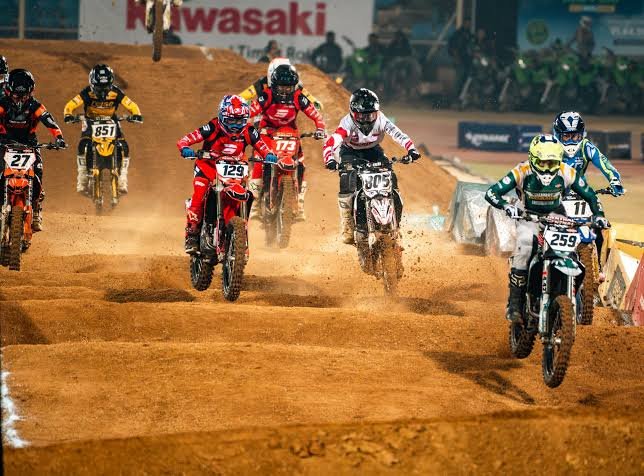
The world’s first franchise-based motorcycle supercross championship is preparing for its most expansive campaign to date. The Indian Supercross Racing League (ISRL) has officially confirmed its provisional Season 3 calendar, expanding its high-flying stadium dirt spectacles across iconic venues in Pune, Ahmedabad, and the National Capital Region (NCR) of Delhi.
Following two dominant seasons where international champions like Matt Moss, Jordi Tixier, and Cedric Soubeyras battled before packed stadium grandstands, Season 3 introduces higher rider salary caps, enhanced technical regulations, and bespoke supercross track designs engineered by certified AMA Supercross track builders.
According to scheduling confirmations published by CarAndBike ISRL Season 3 Coverage, the championship continues to redefine two-wheeler motorsport commercialization in South Asia.
CEAT ISRL Season 3: Championship Framework & Machine Specifications
| Competition Category | Machinery Displacement & Engine Type | Eligible Rider Pool | Notable Champion Entrants |
|---|---|---|---|
| 450cc International (450cc Class) | 450cc 4-Stroke (Kawasaki KX450, KTM 450 SX-F, Honda CRF450R) | World Supercross & AMA Pro Champions | Matt Moss (Australia), Jordi Tixier (France) |
| 250cc International (250cc Class) | 250cc 4-Stroke (Yamaha YZ250F, Husqvarna FC 250) | Top International Junior & National Pros | Reid Taylor (Australia), Hunter Yoder (USA) |
| 250cc India-Asia Mix | 250cc 4-Stroke Production Spec | Emerging Asian & Domestic Indian Riders | Rugved Barguje (India), Ikshan Shanbhag (India) |
| Junior 85cc Class | 85cc 2-Stroke Youth Racers | Under-16 Indian Developmental Talents | Jinendra Sangave, Bhairav Gowda |
Stadium Track Architecture: Rhythm Sections and Triple Jumps
Supercross differs radically from outdoor motocross. Staged inside multi-purpose athletics stadiums—such as the Shree Shiv Chhatrapati Sports Complex in Balewadi, Pune—supercross tracks are compressed into tight, technical amphitheaters requiring over 7,000 metric tons of specially blended clay and aggregate soil.
Riders face an onslaught of manufactured obstacles:
- The Whoops Section: A punishing series of 12 consecutive, tightly spaced dirt moguls measuring 0.8 meters in height. Traversing them at 65 km/h (40 mph) requires skimming the tire tops across the crests using pure rear-wheel momentum.
- The 30-Meter Finish-Line Triple: Launching riders over 10 meters (33 feet) into the stadium rafters, demanding millimeter-accurate throttle control to avoid overjumping the transition into the flat-bottom dirt.
- 90-Degree Flat Track Sweepers: Deeply rutted clay berms where bar-to-bar contact is not just common, but essential for completing block passes under the stadium floodlights.
The Franchise Bidding Model and BigRock Domination
At the heart of ISRL’s sporting longevity is its franchise auction model, inspired by the Indian Premier League (IPL). Competing franchises—including BigRock Motorsports (owned by Dakar legend CS Santosh), BB RACING, Gujarat Trailblazers, Mohite’s Racing Team, and SG Speed Racers—engage in intense bidding wars to secure international talent.
BigRock Motorsports enters Season 3 aiming to defend their back-to-back team championship titles.
Santosh’s squad has mastered the art of squad depth: pairing elite international 450cc race winners who rack up main event points with young Indian riders in the India-Asia Mix category who receive direct technical mentorship from global veterans.
Commercial Footprint and Grassroots Expansion
Beyond stadium entertainment, ISRL’s true legacy is its developmental impact on Indian two-wheeler culture. By including an 85cc Junior category at every round, teenagers from Kolhapur, Bengaluru, and Coimbatore are sharing starting gates and pit hospitality with world-class champions.
With multi-year television broadcast contracts across Star Sports and OTT streaming via JioCinema, the Indian Supercross Racing League has demonstrated that high-octane stadium motorsport can achieve prime-time commercial success in India, creating a sustainable professional pathway for the next generation of Asian off-road racers.