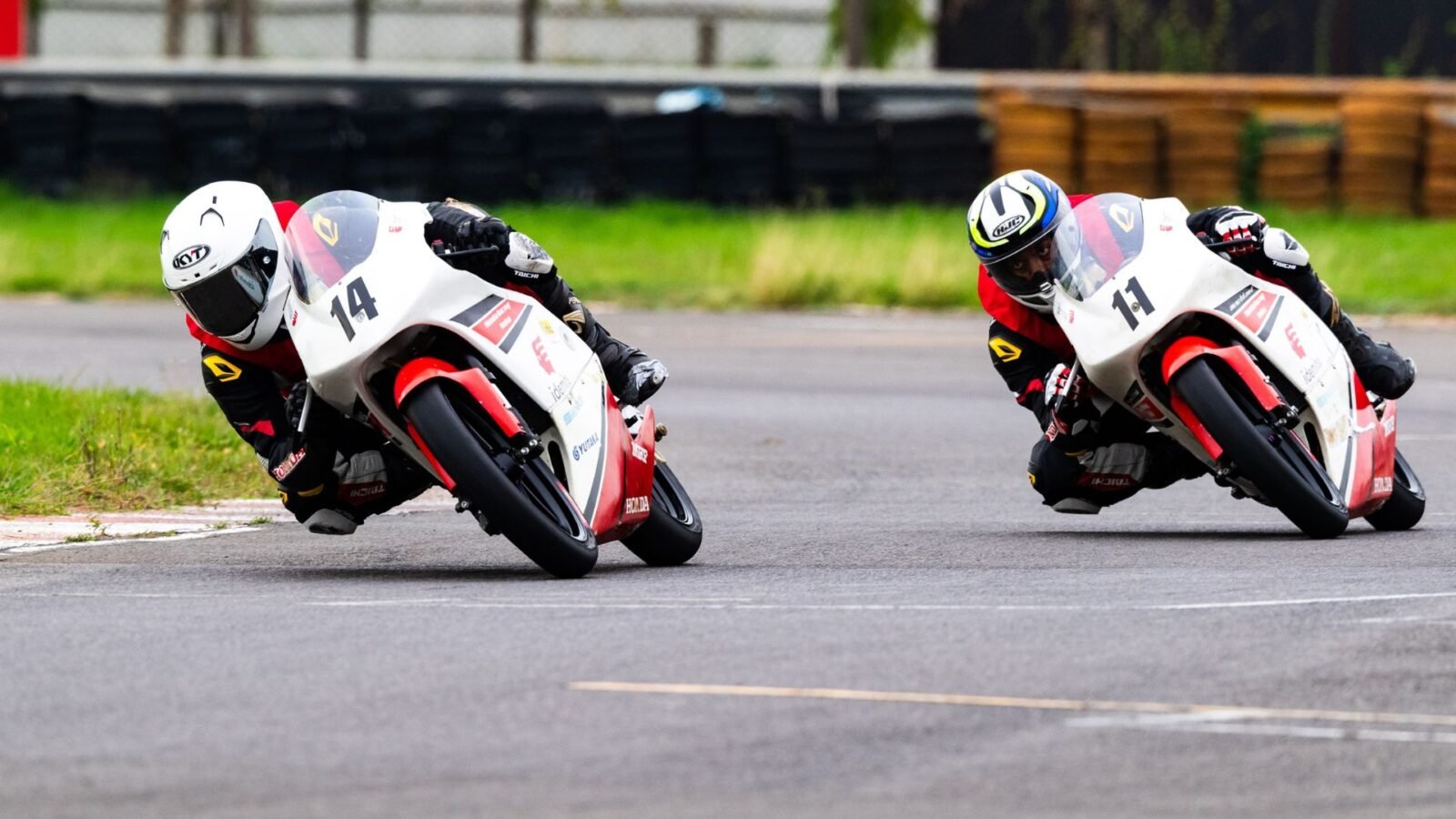
For decades, young Indian road racers who dreamed of competing in the FIM MotoGP World Championship faced an almost insurmountable equipment divide. While European teenagers grew up on factory Moto3 spec machinery, Indian riders had to hone their craft on modified, production-based street commuter motorcycles whose heavy steel frames and road-derived suspension lacked the precision needed for Grand Prix racing.
That structural ceiling was shattered when Honda Racing India introduced the IDEMITSU Honda India Talent Cup NSF250R.
Held across five rounds at the Madras International Circuit (MIC) in Irungattukottai and the Kari Motor Speedway in Coimbatore, the championship places twelve of India’s most promising teenage motorcycle racers on authentic, factory-built HRC (Honda Racing Corporation) NSF250R Moto3 prototype machines.
According to technical program documentation from Honda Racing India Official Motorsport Portal, this single-make platform serves as the direct grassroots conduit feeding Indian talent into the Asia Talent Cup, the FIM JuniorGP, and ultimately the MotoGP paddock.
Honda NSF250R vs Domestic Street Race Bike: Technical Comparison
| Technical Parameter | Modified Production 250cc (CBR250R / R15) | Honda Racing Corporation NSF250R Moto3 Spec | Racing Performance Benefit |
|---|---|---|---|
| Chassis Architecture | Steel perimeter / diamond tube road frame | Twin-spar aluminum perimeter prototype chassis | Exceptional torsional rigidity; zero mid-corner flex at 60-degree lean |
| Engine Configuration | Single-cylinder, DOHC, road-emissions tuned | 249.3cc liquid-cooled 4-stroke single (HRC Titanium Valves) | High-revving power delivery; produces 48 BHP at 13,000 RPM |
| Dry Vehicle Weight | ~138 kg to 150 kg (304 to 330 lbs) | 84 kg (185 lbs) complete race machine | Unbelievable power-to-weight ratio; razor-sharp direction changes |
| Suspension Hardware | Non-adjustable road forks / basic monoshock | Fully adjustable Showa inverted forks and Showa rear shock | Meticulously tuned for high-frequency asphalt damping at MIC |
| Braking Hardware | Standard steel discs / ByBre road calipers | Nissin hydraulic dual front discs (218mm) with race sintered pads | Millimeter-precise trail braking to the apex of chicanes |
| Telemetry System | Basic tachometer / lap timer | HRC 2D Data Recording System (Suspension pots, brake pressure, throttle) | Professional telemetry analysis after every practice session |
The Psychological Shift: Transitioning to 84 kg Prototypes
The immediate shock for young Indian riders entering the Talent Cup is weight and geometry. A production street bike weighs roughly 145 kilograms; the NSF250R weighs barely 84 kilograms.
Because there is almost zero excess mass, the prototype responds instantaneously to rider inputs:
- Corner Entry Speed: Riders who were accustomed to braking 100 meters before Turn 1 at Madras find they can brake at 45 meters, carrying tremendous corner entry velocity into the apex.
- 60-Degree Lean Angles: Running on bespoke Dunlop racing slicks, the NSF250R demands extreme body hanging. Riders must drag elbows and knees across the kerbs to keep the machine balanced on its razor-thin tire edge.
- Rigid Chassis Telemetry: Unlike street frames that flex and mask bumps, the aluminum twin-spar HRC chassis transmits every microscopic asphalt ripple directly to the rider's wrists and spine, forcing them to develop sensitive mechanical feedback.
Telemetry Debriefs: Learning the Global Language of Speed
Perhaps the most transformative aspect of Honda’s academy is technical data literacy.
After every 20-minute track session, riders do not simply discuss feelings with mechanics; they sit down with international Japanese and Indian race engineers to analyze 2D datalogging traces.
Riders learn to inspect throttle opening curves, front brake hydraulic pressure ramp-ups, and suspension potentiometer compression data.
Seeing that a rival is opening the throttle 0.2 seconds earlier out of the final corner teaches teenagers the scientific discipline of Grand Prix racing, bridging the cognitive gap that historically separated Asian talent from European academies.
The Pipeline to Global Grand Prix Racing
The success of the Honda India Talent Cup is already bearing fruit on the international stage.
Riders like Kavin Quintal and Mohsin Paramban—who dominated the NSF250R grid in Chennai—have earned selections to represent India in the Asia Talent Cup and Asian Road Racing Championship (ARRC), competing shoulder-to-shoulder with the finest young talents from Japan, Thailand, and Indonesia.
By investing in genuine Moto3 hardware and world-class engineering mentorship on home soil, Honda Racing India has created a sustainable, merit-based springboard that is systematically transforming India from an enthusiastic spectator nation into a legitimate competitive force in global motorcycle road racing.