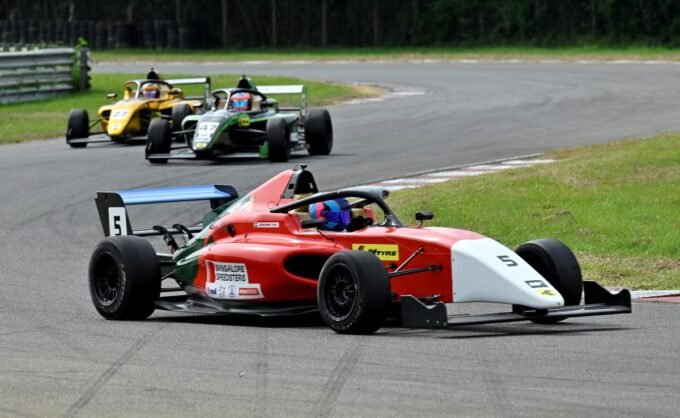

In the dense urban centers of Southern India, motorsport has moved out of isolated countryside circuits and into the bustling civic heart of major metropolitan capitals. From the sweeping shores of Hussain Sagar Lake in Hyderabad to the floodlit coastal avenues surrounding Island Grounds in Chennai, the Indian Racing Festival (IRF) and international sanctioning bodies have demonstrated that temporary street circuits can be transformed into FIA Grade 3-homologated racetracks in under twenty-one days.
However, transforming civilian boulevards into high-speed racing corridors where Wolf GB08 prototypes and Mygale F4 single-seaters reach speeds exceeding 210 km/h (130 mph) is a civil engineering and logistical high-wire act.
According to engineering specifications documented by The Bridge Indian Motorsport, staging street races in India requires laser-guided asphalt milling, subterranean utility cover welding, and the deployment of over 3,000 interlocking Tecpro barrier blocks.
Indian Street Circuit Civil Engineering: Hyderabad vs Chennai Matrix
| Civil Engineering Parameter | Hyderabad Street Circuit (Hussain Sagar) | Chennai Street Circuit (Island Grounds Night Race) | Urban Racing Operational Function |
|---|---|---|---|
| Track Length & Corner Count | 2.835 km / 17 Turns | 3.500 km / 19 Turns | Compact street layout designed for high overtaking frequency |
| FIA Safety Homologation | FIA Grade 3 Certified (Formula E & IRL) | FIA Grade 3 Certified (Night Street Circuit) | Strict safety clearance for open-wheel single-seaters |
| Impact Attenuation System | Dual-Layer Tecpro Barriers & Water Blocks | Interlocking Tecpro Polyethylene Blocks + Catch Fencing | Absorbs 100 km/h perpendicular impact with <15g deceleration |
| Civil Asphalt Milling Depth | 40mm Polymer-Modified Bitumen Overlay | 50mm High-Friction Asphalt Resurfacing | Eliminates civic potholes and road crown crowns for ground-effect floors |
| Civic Infrastructure Prep | 145 Manhole Covers Welded Flush to Road | 180 Utility Trenches & Drainage Grates Bolted Down | Prevents venturi floor suction from ripping iron grates into cars |
| Floodlighting Architecture | Day Racing / Daylight Spec | 100+ Temporary Gantry Towers (>1,800 Lux Lumens) | Broadcast-grade glare-free illumination over coastal sea mist |
The Venturi Suction Threat: Welding 180 Manhole Covers
The most hazardous hidden trap on any civilian road is the humble iron manhole cover. In daily commuter traffic, a 50 kg cast-iron utility grate sits loosely in its collar.
However, when a ground-effect single-seater speeds overhead at 200 km/h, the venturi tunnels between the sidepods and the road surface generate massive negative aerodynamic pressure.
This suction pressure can exert upwards of 1,200 kg of upward vertical lift.
If a manhole cover is unsealed, the passing racecar will literally rip the iron cover out of the street, hurling it into the following car's cockpit or destroying the car's fuel cell.
In both Hyderabad and Chennai, municipal civil engineering crews spend weeks executing "The Big Weld":
- Ultrasonic Inspection: Surveying all subterranean sewage, electrical, and fiber-optic utility vaults along the 3.5-kilometer layout.
- Structural Tack Welding: Arc-welding every manhole frame, drainage gulley, and water-meter lid with high-tensile steel rods flush with the asphalt.
- Polymer Resin Smoothing: Troweling industrial cold-pour epoxy resin around the perimeter to eliminate tire-cutting lip edges.
Tecpro Barriers: The Science of High-Impact Absorption
Unlike permanent circuits with 100-meter gravel runoffs, street racing features zero runoff. The barrier is the boundary.
Instead of traditional stacked tire walls—which bounce crashed cars back into oncoming traffic—Indian street circuits utilize interlocking Tecpro barrier blocks:
- The Composite Absorption Matrix: Each Tecpro block features a high-density polyethylene shell encasing a rigid foam core reinforced with internal steel friction plates.
- Energy Dissipation: Under a 50g head-on impact at 150 km/h, the interlinked Tecpro chain compresses progressively by up to 1.5 meters, distributing kinetic deceleration smoothly across thirty adjacent blocks rather than dead-stopping the driver.
The Night-Racing Lighting Challenge in Chennai
Staging India’s first-ever night street race around Chennai’s Island Grounds introduced extreme electrical and optical challenges.
Racing cars under coastal night conditions requires illumination exceeding 1,800 lux—nearly double the lighting of an international cricket stadium.
Engineers erected over 100 temporary generator-powered lighting gantries positioned at calculated 35-degree beam angles.
This precise angle prevents blinding glare from bouncing off the drivers' tinted helmet visors while ensuring television cameras can broadcast crisp 4K imagery through humid coastal sea air.
Through this triumph of modern civil engineering, Indian street racing has established a blueprint for bringing world-class motorsport directly to the doorsteps of millions of urban sports fans.
Sources
- The Bridge, "Indian Racing Festival: City street circuits and safety infrastructure", September 2024, https://thebridge.in/motorsport
- Autocar India, "Indian Racing League: Street track safety and Tecpro barrier deployment", October 2024, https://www.autocarindia.com/motor-sports-news/indian-racing-festival-round-4-results-433292
- Federation of Motor Sports Clubs of India, "FMSCI Circuit Safety and Street Track Homologation Guidelines", 2026, https://www.fmsci.co.in/
Source: The Bridge: Indian Racing Festival City Street Circuits