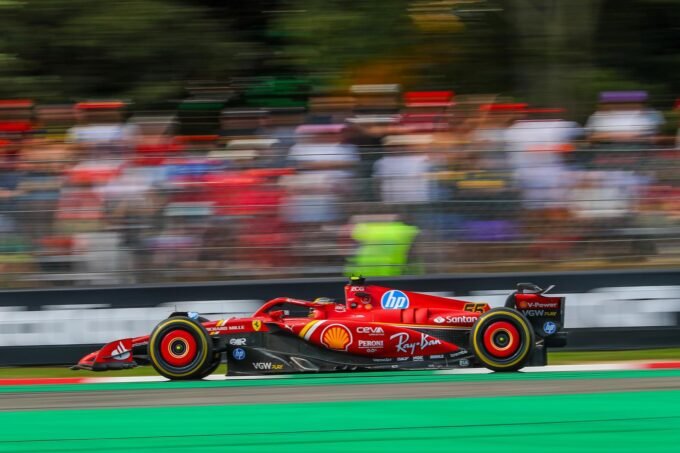

At 2,285 meters (7,500 feet) above sea level, the Autódromo Hermanos Rodríguez in Mexico City presents Formula 1 with its most aerodynamically and thermodynamically bizarre weekend of the entire world championship calendar. Because atmospheric barometric pressure drops to roughly 78 kPa—yielding approximately 22% less air density than at sea-level venues like Monza or Silverstone—Formula 1 cars run maximum-downforce wing packages identical to Monaco, yet register top speeds exceeding 217 mph (350 km/h) down the 1.2-kilometer main straight due to drastically reduced aerodynamic drag.
According to technical analysis from Red Bull Racing Official Guide to Mexico GP Altitude, this thin atmosphere places extreme structural loads on internal combustion engine turbochargers, electrical energy recovery systems (ERS), and brake cooling ducts.
| Engineering Metric | Sea-Level Baseline (Monza / Silverstone) | Mexico City (2,285m Altitude) | Operational Engineering Delta |
|---|---|---|---|
| Atmospheric Pressure | 101.3 kPa | 78.4 kPa | -22.6% reduction in oxygen molecules per volume |
| Air Density ($\rho$) | ~1.225 kg/m³ | ~0.955 kg/m³ | Direct 22% reduction in aerodynamic downforce and drag |
| Turbocharger Spin Speed | 95,000 – 105,000 RPM | 120,000 – 125,000 RPM (FIA Max) | Spooling to absolute mechanical limit to feed 1.6L V6 |
| Cooling Mass Flow | 100% nominal | 78% available mass airflow | Requires maximum sidepod louvers and enlarged brake ducts |
| Main Straight Top Speed | 211 mph (340 km/h) with low-drag wing | 220 mph (354 km/h) with Monaco wing | Massive slipstreaming into heavy braking at Turn 1 |
| Brake Disc Peak Temp | 900°C (1,652°F) | 1,150°C (2,102°F) | Elevated risk of brake pad oxidation and fluid fade |
The Turbocharger Dilemma: Operating at the 125,000 RPM Ceiling
To produce roughly 1,000 horsepower, a modern 1.6-liter turbocharged V6 power unit requires a continuous mass of dense compressed air. At sea level, the compressor effortlessly forces oxygen into the combustion chambers. In Mexico City’s thin air, the turbocharger must rotate significantly faster to ingest and compress the identical mass of oxygen needed for complete fuel combustion.
Under FIA technical regulations, turbocharger shaft speed is strictly capped at 125,000 RPM. Power unit manufacturers (Ferrari, Mercedes, Honda RBPT, and Renault) must carefully manage MGU-H electrical deployment: if ambient temperatures rise, compressors risk exceeding the 125,000 RPM limit. When this threshold is breached, teams are forced to detune engine ignition maps by as much as 30 to 50 horsepower to protect titanium and nickel-alloy compressor impellers from catastrophic mechanical disintegration under centrifugal stress.
The Aerodynamic Paradox: Monaco Wings Yielding Monza Top Speeds
Downforce scales linearly with atmospheric air density. Consequently, even when teams bolt on massive, high-angle-of-attack rear wings and high-rake beam wings designed for the tight streets of Monte Carlo, the actual downforce generated at Mexico City is roughly equivalent to Monza’s ultra-low downforce package.
Cars slide violently through the slow, sweeping curves of the Foro Sol stadium complex as Pirelli tires struggle for lateral mechanical bite. With fewer air molecules traveling across front wing elements and underfloor venturi tunnels, surface grip is at a premium, accelerating thermal tire degradation across the front axle.
Yet, because aerodynamic drag also drops by 22%, the cars slice effortlessly through the thin air down the massive front straightaway. Without the parasitic resistance typical of heavy downforce setups, slipstreaming becomes devastatingly effective, allowing chasing cars to gain upwards of 15 to 20 km/h into the heavy Turn 1 braking zone.
Thermal Dissipation and the 1,150°C Brake Crisis
Cooling a Formula 1 car relies entirely on the mass flow rate of air passing through radiators and brake ducts. In thin air, fewer oxygen and nitrogen molecules pass through heat exchangers per second.
To prevent internal combustion engine oil and hydraulic fluid from overheating, teams cut aggressive cooling gills into the engine engine cover and expand sidepod exits.
However, the most vulnerable components are the carbon-carbon brake discs. Arriving at Turn 1 at 354 km/h (220 mph), drivers apply 150 bar of hydraulic brake pressure, spiking disc temperatures past 1,150°C (2,102°F). Without dense ambient air to evacuate the heat down the straights, calipers experience thermal fluid expansion, forcing drivers into extensive lift-and-coast driving to ensure stopping power survives across 71 laps.
By turning standard aerodynamic theory on its head and pushing forced-induction mechanics to the edge of mechanical failure, the Autódromo Hermanos Rodríguez remains Formula 1's most singular engineering test.
Source: Red Bull Racing Official Guide to Mexico GP Altitude