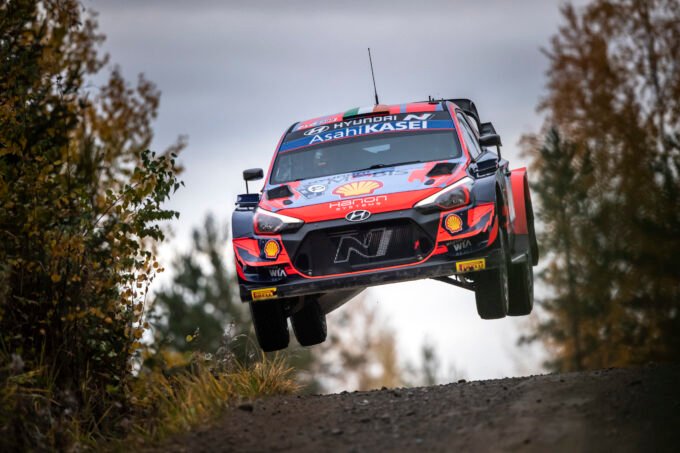

Spanning the borders of Germany, Austria, and the Czech Republic, the Central European Rally (CER) represents the most deceptively treacherous asphalt fixture on the FIA World Rally Championship (WRC) calendar.
Held in late autumn, the rally tasks drivers with navigating narrow rural farm lanes, moss-covered cobblestone village crossings, and high-speed forest switchbacks coated in slick fallen autumn leaves and wet dragged-out agricultural mud.
For championship protagonists Thierry Neuville (Hyundai Shell Mobis WRT), Sébastien Ogier (Toyota Gazoo Racing), and Ott Tänak, the tri-border rally is not merely a test of high-speed tarmac precision; it is a high-stakes psychological chess match governed by tire compound selection, 100 kW hybrid electrical boost deployment, and the treacherous "anti-cut" kerb traps.
According to official rally bulletins published by WRC Official Central European Rally, the rally's unpredictable weather and cross-border road surface variations regularly produce the highest attrition rates in modern World Championship rallying.
WRC Rally1 Hybrid Tarmac Challenge: Central European Rally Technical Matrix
| Technical Parameter / Feature | Dry Summer Tarmac (Rally Islas Canarias) | Central European Rally (Autumn Wet/Muddy Tarmac) | Tactical Racing Consequence |
|---|---|---|---|
| Road Surface Grip ($\mu$) | High and consistent friction ($\mu \approx 0.85$) | Wildly variable ($\mu \approx 0.25$ in mud to $0.70$ dry) | Sudden snap-oversteer when transitioning between tarmac types |
| Tire Compound Selection | Pure Hard / Medium Hankook/Pirelli Slicks | Asymmetric Crossed Soft Slicks and Wet Grooved Compounds | Crews gamble on crossed setups to survive damp morning stages |
| Hybrid Boost Deployment | Standard full 100 kW deployment out of hairpins | Muted / Staged 100 kW electrical ramp-up | Prevents wheelspin on wet cow-dung and leaf-covered tarmac |
| Suspension Ride Height | Ultra-low 90mm ground clearance / stiff springs | Raised by 25mm to 35mm with softer high-speed bump | Absorbs violent hits from deep roadside drainage ditches |
| Anti-Cut Devices & Poles | Standard corner-cutting through verges | Heavy steel anti-cut poles and hay bales at apexes | Striking a post instantly shears aluminum suspension wishbones |
| Brake Disc Temperature | 600°C to 800°C sustained thermal window | Constant cold-disc cooling down wet straightaways | Elevated risk of glazed brake pads into blind downhill hairpins |
The Mud-Dragging Trap: The Road Order Penalty
In gravel rallying, the championship leader suffers by running first on the road, sweeping away loose stones for following competitors.
On autumn tarmac, the situation is completely inverted: running first is a colossal advantage.
As the leading Rally1 cars cut the inside corners of Czech country lanes, their wide tires drag thousands of kilograms of thick, wet agricultural mud and slimy autumn leaves onto the asphalt.
By the time the sixth or seventh car enters the stage, what was a dry, high-grip racing line has mutated into a slippery, zero-friction mud slick.
Drivers running further back must rely heavily on their gravel route-note crews (safety crews who drive the stage ninety minutes before competition starts):
- Relaying real-time corrections onto pace notes ("Cut now filled with deep standing clay").
- Warning drivers of hidden wet cow-dung patches outside farmhouse gates that can cause a 160 km/h four-wheel slide off the road.
Managing 500 Horsepower on Leaves: The 100 kW Hybrid Boost
Modern Rally1 cars combine a 1.6-liter turbocharged internal combustion engine with a 100 kW (134 horsepower) Compact Dynamics electric motor, delivering over 500 peak horsepower when both systems fire simultaneously.
On bone-dry asphalt, dumping 500 horsepower out of a slow hairpin launches the car like a catapult.
On wet, leaf-strewn Czech asphalt, an instantaneous 500-horsepower torque spike will instantly spin all four tires, pitching the car sideways into a ditch.
Engineers program bespoke ECU hybrid boost maps for Central Europe:
- The Delayed Torque Ramp: The electric motor delays its boost delivery until the car is fully straightened out and wheel speed sensors confirm zero slip differential across the front and rear axles.
- Pedal Sensitivity Smoothing: The fly-by-wire throttle response is softened, allowing the driver to modulate millimeters of accelerator travel without triggering an uncontrollable electrical surge.
The Psychological Crucible
With the WRC Drivers' World Championship on the line, the Central European Rally tests mental stamina more than pure bravado.
One moment of over-optimism on a damp downhill right-hander can wipe out a season's worth of championship points.
By combining extreme speed with zero margin for error across three sovereign nations, the Central European Rally stands as a definitive modern testament to the bravery, technical adaptability, and lightning reflexes of world-class rally drivers.