A Masterclass in Low-Carbon Endurance Across Saudi Arabia
The Dakar Rally is universally recognized as the most punishing mechanical test in global motorsport. Over fourteen days and nearly eight thousand kilometres of relentless terrain—spanning treacherous mountain boulder fields, high-speed gravel plateaus, and towering soft sand dunes in the Empty Quarter—the event systematically breaks machinery and tests human endurance. In January 2026, the 48th edition of the legendary raid witnessed a historic triumph: The Dacia Sandriders conquered the Ultimate T1+ category on their first official attempt, guided to victory by five-time Dakar champion Nasser Al-Attiyah and co-driver Mathieu Baumel.
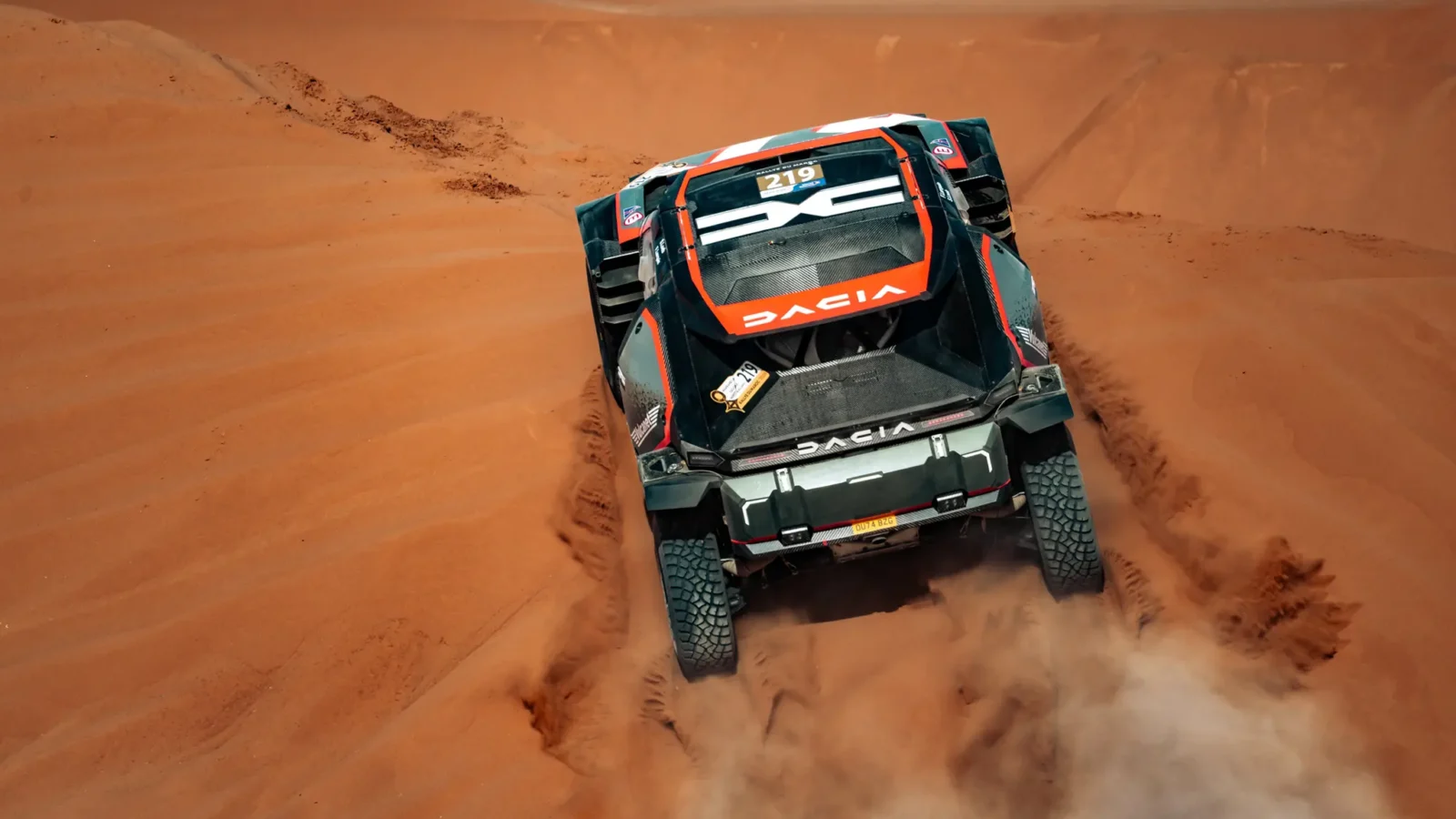
Dacia's assault on the Dakar represented an audacious technical mission: proving that a lightweight, purpose-built prototype running on 100% sustainable synthetic fuel could outpace conventional fossil-fueled factory efforts from Toyota and Prodrive. Operating under the leadership of Dacia Brand CEO Katrin Adt and developed in collaboration with Prodrive engineering, the Dacia Sandrider delivered near-flawless reliability across 4,809 competitive stage kilometres.
Sand Physics: Navigating the Dunes with 37-Inch BFGoodrich Rubber
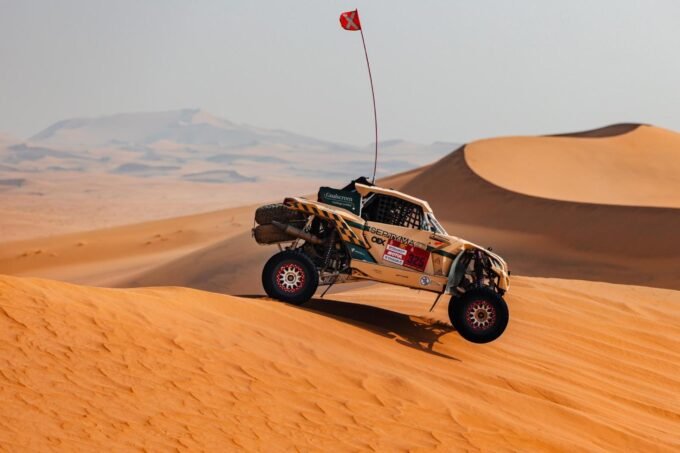
The physical realities of desert rally raiding demand an extraordinary compromise between suspension articulation, weight distribution, and flotation over loose sand. In the dunes of the Rub' al Khali, sand particles possess minimal cohesive strength. A standard vehicle will instantly sink under its own weight, high-centering its chassis rails. The Sandrider counters this through massive 37-inch BFGoodrich tyres mounted on 17-inch aluminium rims, coupled with an onboard central tyre inflation system (CTIS) that allows navigators to deflate tyre pressures down to 0.8 bar while moving.
Lowering tyre pressure elongates the tyre contact patch into an oval footprint, reducing ground contact pressure by over 60% and enabling the 2,000-kilogram machine to glide across shifting crests. Supporting this footprint is an advanced double-wishbone suspension system delivering an enormous 350 millimetres of wheel travel. Sadev sequential six-speed transmissions and mechanical limited-slip differentials distribute torque continuously to all four wheels, preventing single-wheel slip that can dig an unrecoverable crater in soft sand.
Dacia Sandrider Ultimate T1+ Technical Architecture
The mechanical specifications of the championship-winning prototype showcase its purpose-built engineering:
| Engineering Component | Technical Specification | Functional Objective |
|---|---|---|
| FIA Competition Class | Ultimate T1+ Prototype | Premier 4×4 Off-Road Category |
| Chassis Architecture | Tubular Steel Spaceframe with Carbon Body | Maximum torsional rigidity and crash protection |
| Internal Combustion Engine | 3.0-Litre Twin-Turbo V6 Direct Injection | Responsive low-end torque across dunes |
| Maximum Power Output | 265 kW (360 bhp) at 5,000 RPM | Controlled by FIA Balance of Performance |
| Maximum Torque Output | 539 Nm at 4,250 RPM | High-load hill climb pulling capability |
| Fuel Formulation | 100% Synthetic E-Fuel (Aramco) | Net-zero lifecycle carbon emissions |
| Wheel Travel & Dampers | 350 mm Travel; Dual Hydraulic Dampers | High-speed compression control over washouts |
| Dimensions (L x W x H) | 4,140 mm x 2,290 mm x 1,810 mm | Compact overhangs for steep dune approach angles |
Synthetic Fuel Calibration: Aramco Low-Carbon Combustion
At the heart of the Sandrider's competitive performance was its specialized fuel formulation supplied by technical partner Aramco. The e-fuel, synthesized from captured carbon dioxide and renewable hydrogen, was specifically refined to match the volumetric energy density and knock resistance of premier racing fuels. Unlike standard biofuels, which often introduce moisture contamination and corrosive ethanol degradation in extreme heat, the synthetic hydrocarbon blend demonstrated chemical stability across ambient temperatures fluctuating from 3°C during freezing desert nights to 45°C under blistering noon sun.
The 3.0-litre twin-turbo V6 engine mapping was optimized for low-end throttle response. In steep dune valleys, turbo lag can result in immediate loss of momentum and severe bogging. By utilizing twin variable-geometry turbochargers and anti-lag calibration running on synthetic fuel, Al-Attiyah possessed immediate access to 539 Nm of torque from just 2,500 RPM, allowing him to scale 250-metre sand faces without downshifting.
The Legacy of Dacia's Dakar Victory
Across thirteen gruelling stages, The Dacia Sandriders team—which also featured nine-time World Rally Champion Sébastien Loeb and experienced Spaniard Cristina Gutiérrez—claimed multiple stage victories and conceded the overall lead on only a single day. Al-Attiyah's calculated pace management ensured that the car suffered zero terminal suspension failures or catastrophic transmission overheating.
The victory marks a turning point in international cross-country rallying. By proving that synthetic fuels can survive and dominate the most mechanically demanding motorsport event on Earth, Dacia and Aramco demonstrated that the future of endurance off-road racing does not require sacrificing the sound, range, and visceral excitement of internal combustion engines. As the World Rally-Raid Championship (W2RC) expands, the Sandrider blueprint establishes the definitive benchmark for sustainable motorsport engineering.
Sources
- Media Dacia, "The Dacia Sandriders wins the Dakar Rally", 17 January 2026, https://media.dacia.com/the-dacia-sandriders-wins-the-dakar-rally/?lang=eng
- Media Dacia, "The Dacia Sandriders awesome foursome determined to deliver on the Dakar Rally", 2 January 2026, https://media.dacia.com/the-dacia-sandriders-awesome-foursome-determined-to-deliver-on-the-dakar-rally/?lang=eng
- Dakar Rally Official Portal, "Dakar 2026 Ultimate T1+ Official Classifications", 18 January 2026, https://www.dakar.com/
Source: Media Dacia: The Dacia Sandriders wins the Dakar Rally