The Choked Flow Bottleneck
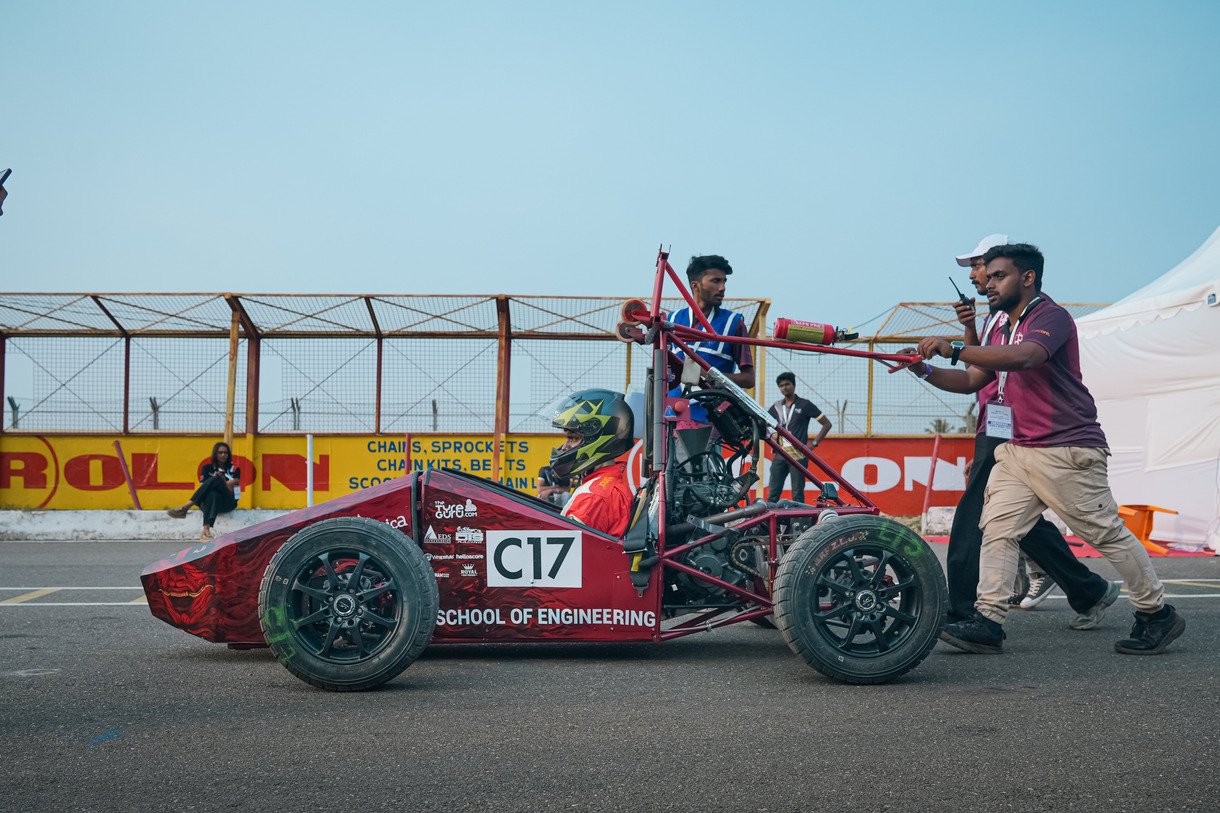
At the Kari Motor Speedway in Coimbatore, where collegiate engineering teams gather annually for Formula Bharat, the definitive technical battleground of the internal combustion category is not displacement, but fluid dynamics.
Under strict safety and parity regulations promulgated in the Formula Bharat Official Regulations, all combustion engines—whether derived from a single-cylinder 373cc KTM Duke 390 or a four-cylinder 600cc Honda CBR600RR—must draw all of their intake air through a single, circular orifice measuring precisely 20.0 millimeters (0.787 inches) in diameter.
For a high-revving four-cylinder motorcycle engine that naturally breathes through quadruple 40mm throttle bodies, choking intake flow through a 20mm restrictor would normally strangle power from 120 BHP down to barely 45 BHP.
Yet India’s leading student engineering teams routinely extract over 80 horsepower and 65 Nm of torque. Here is the fluid mechanics behind that thermodynamic feat.
Formula Bharat Intake Restrictor & Powertrain Benchmark Matrix
| Subsystem Component | Stock Production Motorcycle (KTM / CBR) | Formula Bharat Homologated Intake System | Aerodynamic & Thermodynamic Benefit |
|---|---|---|---|
| Intake Air Throttle Bore | Multi-throttle ~38mm to 40mm per cylinder | Single 20.0mm Circular Restrictor (Mandatory) | Strict mechanical power cap enforced across all combustion teams |
| Nozzle Geometry | Direct straight-runner intake manifolds | de Laval Convergent-Divergent (CD) Venturi | Accelerates airflow to Mach 1 at throat while recovering pressure downstream |
| Plenum Chamber Volume | 3.5 to 5.0 Liters (Stock airbox) | 1.8 to 2.8 Liters (CFD-optimized Carbon Fiber) | Dampens pressure oscillations and ensures equal cylinder air filling |
| Peak Choked Mass Airflow | Unrestricted (>0.12 kg/sec at redline) | Choked Flow Limit: ~0.065 to 0.072 kg/sec | Reaches sonic speed ($M=1$) at 20mm throat at high engine RPM |
| Intake Runner Geometry | Fixed plastic molded runners | Dual-Stage Helmholtz Resonator Runners | Tuned length creates acoustic ram charging at mid-range torque peak (7,500 RPM) |
| Fuel Delivery / ECU | Stock Bosch / Keihin production maps | Standalone Programmable MoTeC M130 / Link G4X | Sequential port fuel injection timed precisely to intake valve opening |
The Physics of the de Laval Venturi Nozzle
- The secret to maximizing mass airflow through a 20mm hole lies in aerospace rocket nozzle theory: the convergent-divergent (CD) de Laval nozzle. If a team simply drills a 20mm hole in a flat aluminum plate, vena contracta effects cause massive turbulent separation, severely dropping the discharge coefficient to roughly 0.62.
- Sonic Choking: As engine intake valves open and pistons descend, intake manifold depression pulls air through the converging section. At the throat (the 20mm constriction), air velocity accelerates until it reaches the local speed of sound (Mach 1). At this point, the nozzle is "choked"—mass flow rate reaches its theoretical thermodynamic maximum.
- Pressure Recovery in the Diffuser: Downstream of the 20mm throat, the diffuser gently expands at a 7-degree angle. This gentle expansion prevents boundary layer detachment, converting kinetic air velocity back into static pressure inside the intake plenum with a discharge coefficient ($C_d$) exceeding 0.96.
The Helmholtz Acoustic Ram Effect
Because the 20mm restrictor strictly caps peak mass airflow at the top end (11,000+ RPM), winning teams tune their engines for mid-range torque to dominate Kari’s tight autocross hairpins.
By calculating runner length using Helmholtz resonance equations, pressure waves generated by the closing intake valve bounce back off the plenum walls and arrive at the cylinder precisely as the intake valve re-opens.
This acoustic ram charging momentarily pushes volumetric efficiency above 105% in the 6,000 to 8,000 RPM band, providing student drivers with instantaneous acceleration out of slow corners.
Through this combination of supersonic aerodynamics and acoustic wave tuning, India’s collegiate engineering talent turns an artificial regulatory bottleneck into a masterclass in internal combustion efficiency.